

Cementing Stem
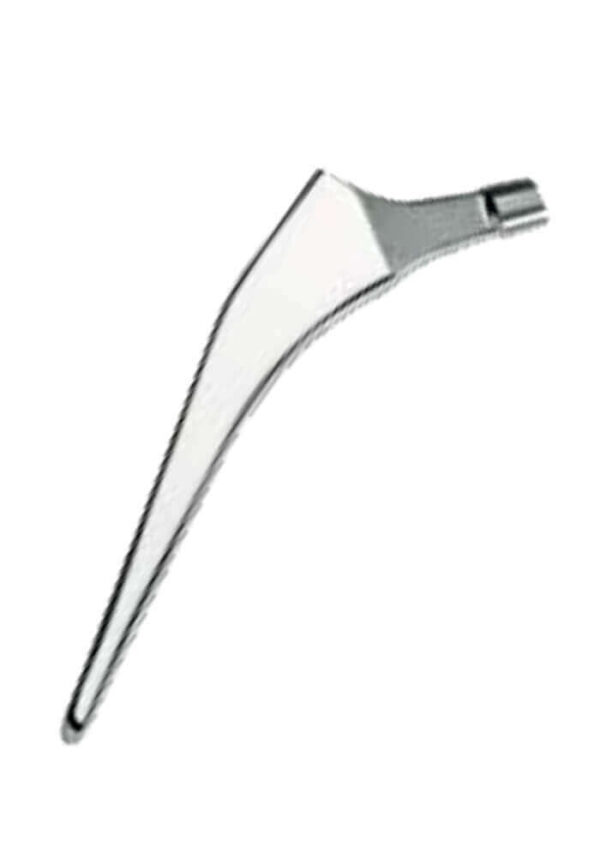
Product Summary
| Cat No./Titanium | Cat No./Stainless Steel | Description |
| L96308 | L96408 | 8 |
| L96309 | L96409 | 9 |
| L96310 | L96410 | 10 |
| L96311 | L96411 | 11 |
| L96312 | L96412 | 12 |
| L96313 | L96413 | 13 |
| L96314 | L96414 | 14 |
| L96315 | L96415 | 15 |
| L96316 | L96416 | 16 |
Product Description
Introduction
In the 1950s, self-curing polymethylmethacrylate (PMMA), also known as bone cement, was introduced in orthopaedics practice for femoral stem fixation by Edward Haboush (New York), Frederick Roeck Thompson (New York), Kenneth McKee (Norwich), John Watson-Farrar (Norwich) and Maurice E. Müller (Bern). Cement was initially used to stabilize or fix hemiarthroplasty stems until Sir John Charnley, in the early 1960s, popularized its use in total hip arthroplasty. Since the 1950s the designs and techniques used for cemented implants have evolved dramatically, based on biomechanical engineering principles and PMMA properties. Nowadays there are a variety of cemented femoral implants that are used for either hemi or total arthroplasty with excellent clinical and radiographic outcomes, but the nomenclature remains confusing. We review these differing stem designs, their respective cementing techniques and geometries, we propose a simple four-part classification system, and summarize the long-term outcomes and national joint registry data for each respective type of cemented prosthesis.
Shagun Cares 1® Cementing Stem overview:
-
Cemented implant fixation design principles have evolved since the 1950s, and various femoral stem designs are currently in use to provide a stable construct between the implant–cement and cement–bone interfaces.
-
Cementing Stem have classically been classified into two broad categories: taper slip or force closed, and composite beams or shaped closed designs. While these simplifications are acceptable general categories, there are other important surgical details that need to be taken into consideration such as different broaching techniques, cementing techniques and mantle thickness.
-
With the evolution of cemented implants, the introduction of newer implants which have hybrid properties, and the use of different broaching techniques, the classification of a very heterogenous group of implants into simple binary categories becomes increasingly difficult. A more comprehensive classification system would aid in comparison of results and better understanding of the implants' biomechanics.
-
We review these differing stem designs, their respective cementing techniques and geometries. We then propose a simple four-part classification system and summarize the long-term outcomes and international registry data for each respective type of cemented prosthesis.
- https://www.shaguncares.com/